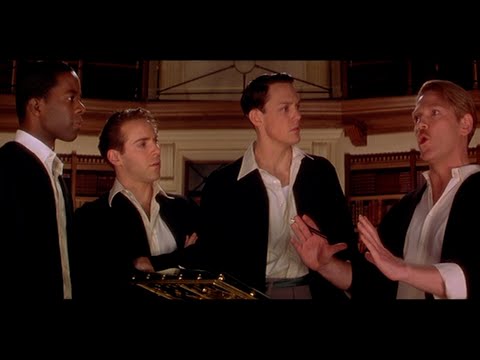
It’s hardly Shakespeare (only about 1/3rd of the script is here) but I’ve seen this play properly done and left feeling very meh about it.
I love the mash up musical thing. I love the slapstick. I think both of those are 100% in keeping with the spirit of the play.
This isn’t a serious work, we are not watching Hamlet. The worst thing for me about this film is that it’s poor box office take meant that my dreamed of Branagh Shakespeare opus was curtailed.
The critics were pretty split on the 2000 Love’s Labor’s Lost. I agree that it was uneven. I found the lack of singining and dancing skills on display here to be disappointing and occasionally jarring.
But!
It worked. The whole thing an homage in honor of 3 things beloved of Branagh.
Golden age Hollywood,
Vaudeville,
And Musicals.
He clearly adores these things and they are lovable in his production. I’d argue that despite the heavy script editing, these honorees have a completely justified space in any Shakespearean comedy production. They fit with the spirit of the play and despite a few uninspired notes I think this is a wonderful version of Love’s Labor’s Lost.
It’s a nothing burger of a story. 4 dudes swear a vow of chastity.
Four smart beauties apear.
Dudes are conflicted, hijinks ensue, some extra singing and dancing and mistaken identities occur and then happy end happy end.
I have not found myself smiling so much while watching entertainment in a long time.
I hummed Gershwin for days and thought about people who I thought should see this one.
Special shout outs to Branagh whose delivery is impeccable and to Nathan Layne who embodies every great thing about a fool and somehow avoids every off putting thing about that type. Tricky!
This is my first real exposure to The Winters Tale. I hadn’t read it or seen it preformed before and was casually avoiding it.
I enjoyed it way more than I thought I would and I’m glad to have seen it.
We had a rough time finding an appealing production, and had our hearts set on the Branagh, because Branagh.
It was almost impossible to find and we’d nearly given up when Kelsey found us a source. Thank you Kelsey!!!
This play is a late period (1611) Shakespearean work and has a strong depressing first half, and a relatively weak and predictable back half.
If it weren’t for Branagh and Dench (and a startling return-to-form scene at the end) it probably would have gotten 2 stars from me.
The language was a joy to sit and wallow in and the story was appropriate to the ancient Greco Roman types.
The problem here is that Shakespeare and I have fairly different ideals when it comes to Greco Roman types.
Here’s how it goes: A king goes mad and calamity ensues, innocents die, long persevering servants triumph with moral clarity.
Things I liked about this play: the production especially the dancing and the heavier psychological elements and of course Branagh and Dench were all great.
Dench has the role of stiff backed Jiminy Cricket. She is holding unwaveringly, to truth and justice throughout. She inhabits this inflexible uprightness perfectly.
Branagh is the passionate, paranoid and impulsive king and he swings majestically (bipolar like) between rapture and explosive rage in true heroic fashion. His delivery gets special mention here, so smooth and so natural, it makes even this jackknife/random behavior feel possible if not likely.
I liked the home movie setting of the kings friendship in the beginning, very much. It’s a short establishing exposition but I bought it completely and felt seated into the reality of the relationships effortlessly.
I was delighted by the surprise of the Bavarians and shepherds all being good dancers, also I was surprised by the sexiness of the pastoral dance parts, a little ballet and mostly modern.
Things that missed for me: it was dark and I don’t think that was the video so much as the stage design. I spent an uncomfortable amount of time squinting at my screen.
My primary complaint, and this is a failing of the play and not the production, the pacing was off and the happy ending felt like an afterthought. What can you do? I’m not the first to have this problem with this play.
I doubt I’ll watch it again and I doubt I’ll look for another version but I’m glad I’ve seen it.
I usually read a bit about these plays when we watch them and found in Wikipedia this compelling argument for analysis .
Eric Ives, the biographer of Anne Boleyn(1986),[4] believes that the play is meant to parallel the fall of that queen, who was beheaded on false charges of adultery on the orders of her husband Henry VIII in 1536. There are numerous parallels between the two stories – including the fact that one of Henry's closest friends, Sir Henry Norreys, was beheaded as one of Anne's supposed lovers and refused to confess in order to save his life, claiming that everyone knew the Queen was innocent. If this theory is followed, then Perdita becomes a dramatic representation of Anne's only daughter, Queen Elizabeth I.
As a play, this was not a very good play. It's weird because this was a late play of his but it felt like he was just learning how to write some of his tropes. This was again, the man who falsely accuses his pure wife of cheating on him on the flimsiest of excuses. À la Much Ado About Nothing and Othello. Sorry, I don't even have Muslim outrage anymore. It ran out with Othello.
The story roughly goes that king and queen invite their childhood friend, other king over for a visit.
He is leaving and king says to other king please stay. Other king declines. King asks queen to press other king. Other king gives in and stays. King decides this means they've been cuckolding him. He throws out queen and their newborn daughter. Their son, a child, dies of heartbreak.
Queen dies. Newborn child is left to die of exposure but is saved by someone passing by.
Other king escapes with barely his life.
Time jump. Princess is growing up as a peasant but has caught other king's son's eye to other king's great offense. The two run away to the next kingdom which unbeknownst to them is actually her father's kingdom.
Due to a series of events (which involve a seer to divine she's the princess), she is restored to her family and turns out queen didn't even die, she was pretending to be dead. Everyone is reunited except the dead prince who is really dead.
This dry narration isn't me making a joke haha. It's actually what happened.
I lied, I was a little outraged about the accusation of adultery based off of the woman doing what the man asked her to do??? I went through some rumination on this. He used this plot point of false accusation so frequently that I wondered if Shakespeare was trying to point out that it's CRAZY to accuse a woman like this? But then this was supposed to be a tragicomedy, starting dark and ending well. Then I wondered if he'd falsely accused his wife of adultery or wondered if she did cheat on him while he left her in the countryside. Then I wondered if actually she did cheat on him. Then, I thought, well who knows.
A typical Shakespeare rumination.
I think the play itself was boring which surprised me because at this point Shakespeare is wealthy. If he doesn't have a good idea, he doesn't really have to write, does he?
But Kenneth Branagh did a fantastic job just adding atmosphere to it. It starts with a cozy Christmas family scene.
He manages to get Judi Dench who has great delivery. That voice of hers is very moving.
The fun musical scenes were actually good entertainment although I didn't understand the song at all. The singing was quite good.
The queen did a great job of pretending to be a statue at the end and she was quite beautiful. Most of the stars are to the actors and producers.
We have Kenneth Branagh's Love Labour Lost next. We are quite lucky to be in his time of Shakespeare productions, so I'm looking forward to it.
We continue the War of the Roses with Henry VI. In this installment the kingdom falls further apart. The people and plots get nastier and more personal and the foley guy gets to make lots of squelching sounds from all the bloody conflict.
I hadn’t read or watched these plays before so I can’t speak to how well done the 2&3 amalgamation was, but like all the Hollow Crown Henriad it was beautifully shot, well cast and sumptuously dressed.
Mariam finished before I did and wondered what I would think of Cumberbatch as Richard III.
I love him in the role, my favorite is Ian McKellen in his creepy fascist Richard III.
In the same way that Henry IV part 2 is really just Hal the preview, Henry VI part 3 seems to be Dick the preview.
That’s all for the good as far as I’m concerned.
Cumberbatch is unhinged and menacing and captivating in all the right ways.
This comes as a startling relief as most of the other characters/portrayals in Henry VI parts 2 and 3 leave me cold.
York is vacillating , Lancaster is unlikable and uninterested.
Margret has fallen off the deep end into unsympathetic rabid one dimensional farce.
Oddly it’s the weak Henry VI who holds me most here but there’s not a ton to watch from him.
Hats off to Tom Sturridge.
I’m glad this one is finished but also glad I’ve actually finally seen it.
3 stars for beauty of production, but it was an ugly play.
Mom score 4 stars.
Margret despite her many and varied faults seems to have been a very good mother.
If I were to use one word to describe this play, it would be "disgusting". Concretely, abstractly, physically, and spiritually disgusting.
We start off with Somerset immediately having his head chopped off. By a peasant no less. He was dying anyway, so he asked the peasant to let him die by nobler hands. To no avail. He was not a great guy to the end.
Margaret Anjou is devastated. By now, Henry VI does have a clue about their affair and pathetically observes that she wouldn't mourn as much for him. Sigh.
In all of this, some random noble is killed. This random noble's son vows revenge against the Plantagenets.
But meanwhile, Henry VI agrees to give up his throne to Plantagenets after he dies, disinheriting his son. It was pathetic, I agree, the way he did it but Margaret Anjou, in what I would presume is an act of treason rounds up her own people, goes over to the Plantagenets home, kills the the Duke of York, burns the house. Random noble's son kills the youngest son. Richard Plantagenet, who has a crooked back, a disabled arm, and a limp (not in real life it turns out) watches selfishly and cowardly from behind a wall while his brother dies.
Ok, now Plantagenets round up, to supposedly fight Henry VI, but really it's Margaret Anjou. Henry VI hides from the fighting and descends conveniently into madness at this moment.
Richard stabs random noble's son who did get a little cocky because of the bad arm and then to make it a hard death, doesn't chop off his head. That was a bad scene.
Margaret Anjou is routed and runs off with her son to France. Henry VI runs around in naked ecstasy for a while and then is thrown into the Tower of London.
The eldest York son, Edward becomes king.
Then falls inconveniently in love with some random woman just when Warwick Kingmaker has promised an alliance between Edward and the French king's sister. The French king:
French king's sister who hasn't even met Edward is heartbroken and Margaret Anjou takes this moment to stir up a fight between the two countries.
Warwick sensing that he's in trouble here immediately switches allegiances to Margaret Anjou and her son. That was pretty pathetic too. And I think bad writing because except for this scene, he's a good character and well-written. It was much too abrupt.
Richard and George are pretty disgusted by their brother and his loose pants but George takes it a step further and says he's siding with Warwick and Margaret Anjou. Warwick agrees to let George marry his daughter. I thought for a second here Henry VI would conveniently regain his sanity in time to try and reclaim his crown but he doesn't. Instead he gives his son his blessings to go and try to get it for himself.
Edward:
And his detested wife:
By the way, this whole plot line of a king being ruined by his love marriage sounds familiar, no? (Henry VI and Margaret Anjou.)
Off they go to face off the Plantagenets and George sees his brothers and then immediately turns again. He changes his mind as fast as that guy from Katy Perry's song. Sadly, he's already married to Warwick's daughter and Warwick is really worried about this.
Warwick dies, asking his daughter be taken care of. Margaret Anjou is captured. Her son killed. Richard goes off and kills Henry VI in the Tower of London, deciding that since women don't even like him, he's just going to become king even if it's by killing everyone. (Seriously he says this. He was the original incel, I found him.) Edward and the random lady everyone hates have a son. Richard laughs villainously into the camera as he plans on how he's going to kill the babe.
The end.
If you're not sure what happened, it's ok. I don't think words are the right way to keep track of this. So far it was: Richard II, Henry IV, Henry V, Henry VI and now Edward. Richard line, Henry line, Henry line, Henry line (red rose), Richard line (white rose). Remember they're all cousins, so really this is too much family drama the public has to put up with.
They went hard on the rose imagery.
They did some Jesus imagery which, since this is the York guy, nicely ties back to Richard II and his original Jesus imagery.
They tossed around heads and desecrated them quite a bit in this show. It was unamusing. If I'd gone on this play alone, I'd say the whole lot of the English were barbaric savages. Ugh.
And with this, we've gotten through half of the Shakespeare plays! I think we're going to finish the whole list in two years instead of one, but we're still going at a steady if slower pace than in the beginning.
Oof, a rough poem. I listened to the summary before I started so that I wouldn't be confused. It's pretty good.
These are my two main thoughts after listening to the poem.
One, the audio version that Missy and I both listened to was quite good in getting emotion across. There's a scene where Lucretia was angry and for that I was grateful. She should at least be able to be angry.
This takes me to my second thought. The whole thing ended up being surprisingly modern to me. She wasn't just that chaste, beautiful woman, her husband had boasted about. She wasn't meekly available for the picking. She was angry. She TOLD on him, which good for her. I had been worried she would be found out and accused of an affair. She threw herself into painting, which again felt modern to me, but here is the proof to the contrary.
Even how everyone reacted felt modern. The men in her life did take her side even though the little detour into who took her side more was...uh, one way of grieving, I guess. Society took her side. They overthrew the whole government by taking her side.
I know there was a Roman Republic, but I often think of Rome as empire and the ones who treated the Isrealites as second class citizens and...well, Jesus and all that. Tyrants.
I KNOW it's not true. I've read and seen Julius Caesar after all, but it's always gratifying when you see that an ancient people aren't brutes as compared to our civilized democracy. Also that trad dads and Bronze Age Pervert or whoever are wrong about the historical past and they'd be driven out of a Roman Republic town on a splintery rail (probably dead as a doornail if this poem is any indication) for trying the "your body, my choice" garbage.
The Rape of Lúcrese is a narrative poem published early in Shakespeare’s career.
In it, the powerful son of a corrupt king rapes the beautiful and virtuous wife of fellow officer and aristocrat.
The beautiful and virtuous wife, Lucretia, then kills herself. Her death is the catalyst for an uprising that banishes the royal family making room for the noble Republic.
Unlike the plays, this is a work that Shakespeare published himself. It contains his edits and his introduction. It’s his 2nd published work and one that he referred to as a grave labor.
I like this poem.
I listened to a full cast version today at work and had the text on my phone for reference.
Here are my thoughts in no particular order.
On the weird relationship between England and Rome
This gives both Lucretia’s pondering the painting of the fall of Troy and Shakespeare’s embrace of a classical canon an interesting weight.
There was some fellow feeling here because Mythological Rome was also founded by a descendent of Aeneas (Romulus). All of this means that when Elizabethan writers and thinkers refer to the classics they feel that they are being self referential.
They read and write in Latin (if decreasingly) and the education standard is that of classicists. Everybody wanted to be Cicero.
It’s worth bearing in mind when considering Shakespeare’s motivations in attempting this work.
On Suicide
Although the Roman ideal of suicide as a noble act was the inevitable crux of the poem, it left me wondering at the English valorization of it.
This happened previously in Julius Caesar and I’d wondered the same thing.
I feel like, in the latinophile world of renaissance England, you can see the dawning of the age of reason peaking through. Shakespeare lived in a heavily Christian society in which suicide was one of the very few unpardonable sins. But everyone venerated Rome and Roman thought. The worshipful attitude for the Greek and Roman classics were a rising tide that swept over the accustomed standards of the church, within the next hundred years or so.
On Rape
I’m a huge fan of martial arts movies. There is this standard trope in them (and in movies generally) where an innocent woman is raped. That rape is the turning point for the hero. He must now avenge her. He must now choose violence.
Rape is a plot device. Rape is a spectacle, often prurient.
The woman usually dies because she’s now dirty but her death redeems her.
This is a cynical and infantilizing impulse, usually coming from men for whom rape is an abstract occurrence.
This is exactly what happens in the Rape of Lúcrese.
It is is completely typical of stories from male dominated cultures.
It’s not like rape can’t happen to men but let’s be honest here, it’s a lopsided representation.
Currently about 1 in 5 women vs 1 in 71 men have experienced completed or attempted rape.
All of this to say my sympathy and patience with this plot structure is very low and the fact that it’s coming from a great writer (Shakespeare) or from canonical greatness (Virgil) doesn’t change my opinion much.
Women are not plot devices.
A culture that treats women as inhuman can’t quite get that.
On the Poem Itself
Shakespeare is so good at the human condition.
He’s good here at Tarquins vacillation and rationalization. He’s good at Lucretia’s desperate arguments.
He riles us up with her tragedy.
The things I want to praise here are later though.
His exploration of art as solace for pain:
That she with painted images hath spent;
Being from the feeling of her own grief brought
By deep surmise of others' detriment;
Losing her woes in shows of discontent.
It easeth some, though none it ever cured,
To think their dolour others have endured.
I also really liked the portrayal of the competitive and inappropriate impulses that can make grief especially ugly. When in their sorrow, her husband and father argue over who she meant the most to:
The one doth call her his, the other his,
Yet neither may possess the claim they lay.
The father says 'She's mine.' 'O, mine she is,'
Replies her husband: 'do not take away
My sorrow's interest; let no mourner say
He weeps for her, for she was only mine,
And only must be wail'd by Collatine.'
'O,' quoth Lucretius,' I did give that life
Which she too early and too late hath spill'd.'
'Woe, woe,' quoth Collatine, 'she was my wife,
I owed her, and 'tis mine that she hath kill'd.'
'My daughter' and 'my wife' with clamours fill'd
The dispersed air, who, holding Lucrece' life,
Answer'd their cries, 'my daughter' and 'my wife.'
On Easter Eggs
The Wikipedia article on this poem had a nice section on other works of Shakespeare that referenced this story. There are quite a few and that sort of this is always fun for me to look at.
But the Easter Egg that I most enjoyed was the presence and moral leadership of Brutus.
This is Lucius Junius Brutus, the ancestor of the Brutus (Marcus Junius Brutus) from Julius Caesar.
Here he preforms the same role of galvanization and piety over a bloody knife.
He brings the bickering family in line and rouses the people against tyranny. He causes them to kneel to the gods and he kisses the bloody dagger and swears justice. The people follow him and you can almost hear ‘Friends Roman’s Countrymen’ echoing behind him.