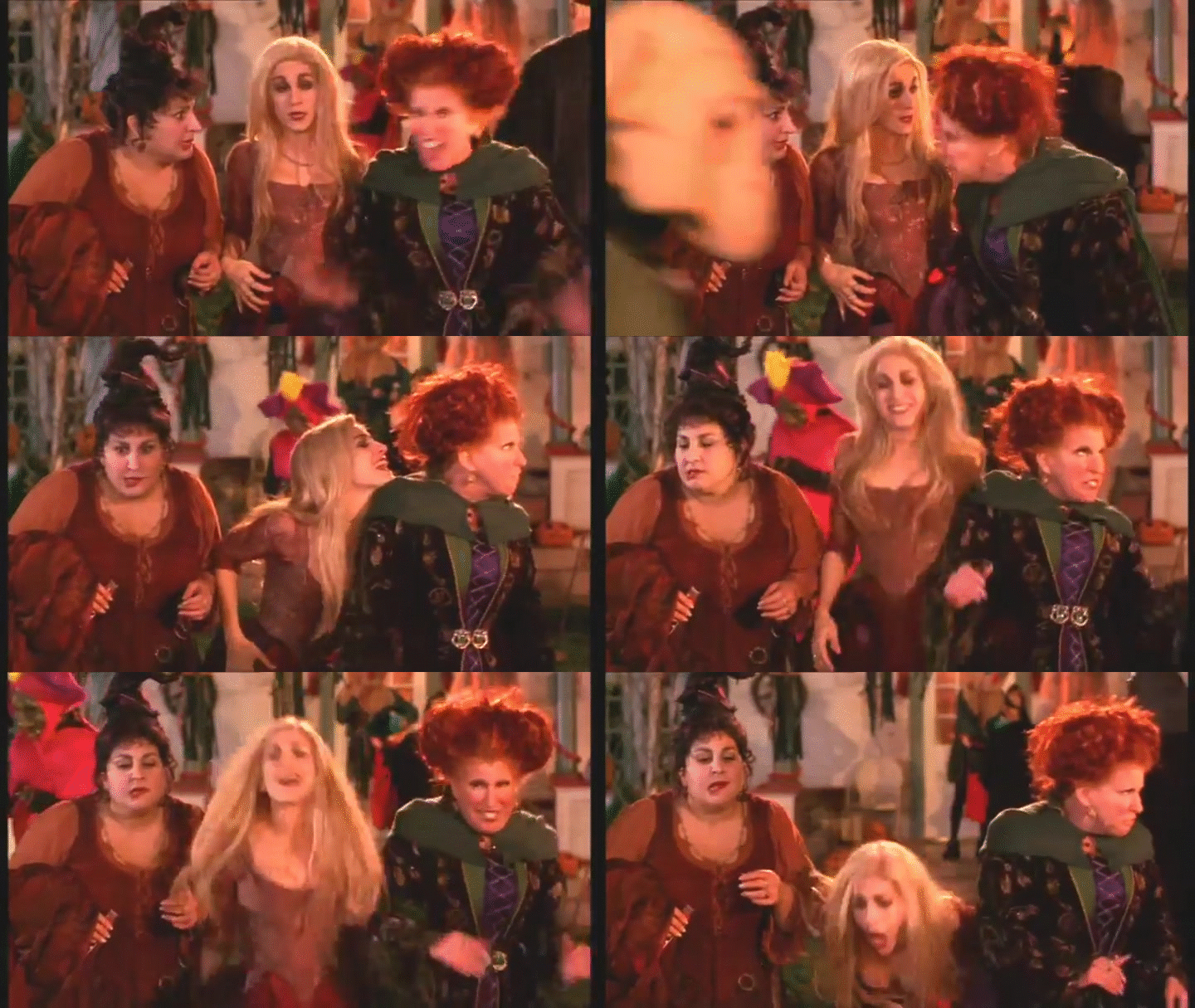
I love the Henriad and I enjoy many things about the War of the Roses . That whole conflict was set into motion largely by the events depicted in this play.
The first version I saw of this play had Richard as some sort of homophonic’s idea of an effete lily livered coward and Henry Bolingbrook as a basic John Wayne swaggerer.
This version is the first Richard II I loved. I bought the DVDs as soon as they came out and my mom bought them for me later that year for my birthday. Apparently I also bought them from Amazon because when I looked it up to rent it I found that I last watched it in 2023 when I purchased the series (ha thanks ADHD).
Things I love about this version: sets, casting, delivery.
Things I don’t love: it’s fairly dense and I’m glad we started with other plays because this is one that takes some Shakespeare in the ear. Don’t get me wrong, the language is beautiful and its complexity, especially in Richard’s case is fully intentional.
Mariam was looking forward to getting to the histories and here we are. I very much hope she’s likening them so far.
The sets were beautifully shot but were also, in and of themselves, beautiful. Everything here was shot on location and for the most part the palaces and forests are still mostly as they were. When my little SCA loving, history buff of a heart imagines the best things of the Middle Ages this is the stuff. Many things are in their platonically ideal state in this series. There are castles and knights and bowers and bridges all worth drooling over. I don’t tend to think of backgrounds as lush but Richard’s tent or the simple throwing stones into the river scene, during the ‘planning’ of the Ireland campaign, are just plain lush.
The delivery here is tricky. There is an awful lot of iambic pentameter in this play. There are many many speeches that could as well be lists. There is the floral speech of the elite aristocracy and very little else for many scenes.
It’s delicate work to be true to the text and not off putting to the modern ear, with Richard II. I feel like they did a bang up job. The delivery felt authentic and poetical. It felt idealized rather than patronizing.
It’s the cast though that takes this one to 5 stars. I love Shakespeare but I don’t throw my 5 stars around without consideration.
Ben Wishaw, who I adored as Ariel in our recent Tempest watch, IS Richard II. He got the BAFTA for this and it was well deserved.
His Michael Jacksonesque money and sense of celebrity leavened with a risible messiah complex make for a riveting watch. He speaks poetry like conversation and pushes camp to a complexity rarely matched. He’s earned the 5 stars all by himself.
Look at his moods here.
He is a figure that would make my daughter yell “Slay”. He’s full of drama and grandeur and I love him.
He’s a terrible ruler though.
The Divine right of Kings is at issue here and boy is it an issue.
His cousin Henry Bolingbrook is honorable and ambitious and Kingly in most other ways. He’s also in the end a traitor.
I like very much the portrayal here by Rory Kinnear. He is a little at a loss, most of the time, and has both real affection for his cousin and a constant internal battle when obeying his orders.
I like that he feels so aware of himself throughout. He lies to himself and others to justify his actions, but he knows it. The rationalizations are sensible and inexcusable.
But also, and especially to a modern American non monarchist, he is right.
My shout out this time goes to Patrick Stewart. John Gaunt/Old Gaunt is a small part, if pivotal, and I’d forgotten that he was even in this version. Then I saw him and couldn’t believe I’d forgotten. He is great here, sympathetic and honorable and full of righteousness indignation.
Three cheers for Patrick Stewart (his Macbeth is also worth a look).
The Hollow Crown series was made for the British Cultural Olympiad in 2012 when they had the Olympics. I wish that every nation would do one of those. What a gift of funding and energy and what a jewel of accomplishment.
The Histories don’t get as much love as they deserve and I’m so glad to see the Henriad get this treatment.
I know some reviews of this production have called it pandering but I am fine with that. Pander to me. Make the plays seem beautiful and sordid and scandalous. Shakespeare is all of those things. They are lascivious and they are thought provoking. I roundly reject the critics who tried to fault this production.
Richard II - 5 stars for cast and watchability
Mom score - 4 stars for the Duchess of York pardon scene. It’s not a 5 star as it’s such a small part but excellent moming and a bonus for her little scold at the end.
If you want a fun War of the Roses recap please watch this Horrible Histories video summary.
I know Horrible Histories is gross and juvenile at times but it’s just so darned good.
It used to be my son’s favorite show and it delivered him
into kindergarten with a fully accurate rendition of the full lineage of the Kings and Queens of England from Athelstan on down.
That boy could do you a history list like some kids do dinosaurs.
Well the 2015 Macbeth was certainly a beautifully shot version of that play. Also it was brief. This is Shakespeares shortest tragedy and they edited it down even further. It’s my 4th different version of the play and probably my second favorite.
Things I loved.
The two stars Michael Fassbender and Marion Cotillard were fantastic.
The score was eerie and slow. The scenes, every single one of them were peak artistic expression.
If you haven’t seen this version have a listen here to the score.
Also you just cannot beat Scotland for haunting beauty. I have this thing where I am sometimes nostalgic for things I have never seen. I miss American Chestnuts and I miss the Isle of Sky in this way.
10/10 for location shooting here.
I liked the semi Bravehart war make up and the shifting into madness color palette. I liked the fight choreography. I liked the witches deadened delivery and I liked the bloodiness.
I mean come on. Look at this!
Things that startled me. The youth of Fleance, who I had always envisioned as a young man, pulled at my heart. The beginning with the death of the young Macbeth(s), was something I’d often thought of but I hadn’t expected to show up on screen. The number of witches that ignored my preconceived maiden, mother, crone triumvirate of witchcraft sort of bothered me. Plus I kept thinking about James and his occult obsession
I adored the out damn spot scene It was great as delivered but after the pan to show her child on the floor with her it became bar none the best version of that soliloquy that I’ve ever seen
I don’t think this scene can be topped. This is probably peak out damn spot.
I did not like how Macbeth instead of shrinking from personal violence after killing the king, charged headfirst into it. I’ll admit it felt very in line with the self destruction of the character and fed into the madness of his wife. It even granted a sort of “You asked for it!”, pathos to her break. But it hurt my feelings and I didn’t enjoy it. I especially did not enjoy the burning of the MacDuff family.
Things I feel about this play:
This has always struck me as a pandering supremely Jacobean work and I’m less enthusiastic about James than Elizabeth. That being said I find this to be one of the very few works of Shakespeare that benefits from hard thinking character analysis.
When Iago is a villain it doesn’t really matter why. When the Capulets fight the Montiques the origins of their dude is irrelevant. Even in the comedy’s motivation and genius’s don’t count.
With Macbeth it all matters.
Hamlet and Macbeth share this actor problem. The ‘is he isn’t he’ of the madness and the difficulty of playing these parts as sympathetic (or at least believable enough) when they act so strangely.
Fassbender was a flawed and fragile man pushed and self deluded into a very recognizable self destruction. I loved this portrayal but it didn’t represented the hard fall the text indicates, because he started in the edge then slipped over it so seamlessly.
I’m glad I saw this version. It made me think as much as it made me feel and that was great. Because of my mom score tracking it made me think again about women in Shakespeare.
I feel like Shakespeare didn’t get women the way that lots of male writers don’t. But then I think well it’s not a book it’s a play and only archetypes will do for some versions of theater. Then I think I’m too temporally removed from era to know if he’s misunderstanding and misrepresenting or if my assumptions about the female voice are just as off.
Then I wondered if he is great with the male voice.
So I asked my husband.
Do you think Shakespeare understands men? He said some men sometimes. Ugh
I am hoping to convince him to write something small here about it. I’d also like to see if our friend Donnie has thoughts about this.
Fassbenders Favorite version of this play is Throne of Blood and I’m thinking more and more that when we finish this list we should go back and do recommended alternative versions.
My favorite version by far is the 2005 Shakespeare ReTold BbC series MacChef version.
Macbeth 2015 - 4 stars for beauty and the leads minus a tiny bit for editorial choices that I don’t even entirely disagree with.
Mom score - ooofff I’m not sure what to say here. I think lots of the things Shakespeare gets wrong about the essential nature of women are corrected here.
I see too many of James’ female hangups in Lady Macbeth to read the character as anything other than propaganda. On the other hand she just works. She sticks with you because she’s got so much depth. Maybe it’s just that she’s a great cipher.
If this is interesting to you I recommend having a look at this video about James coming to the throne of England.
I’ve linked a lot of videos here and asked for outside voices and all of that is a sign that this play did the thing that good theater can do, and scrambled my brain a bit.
Three cheers for Shakespeare.
I need to make a further adenda here. The great author Dorothy Dunnett wrote a book called King Hereafter which is an historical fiction version of the story of a posited Macbeth.
It’s the only book of hers I have not finished despite my adoration and this post has reminded me that I mean to do that.
Of all the plays, I think this is the one I least understand the text. There is a significant amount of supernatural, ravings, and internal monologue that makes it difficult to follow. The audiobook was therefore a 2, probably due to the nature of the play.
I did listen to it while driving into Alleghany County, where the mountains are turning golden from autumn and I was reminded of the fact that this mountain range was part of the same range that is in Scotland before Pangea split apart.
Maybe I'll give the audio experience a half extra star for atmosphere.
But notable lines that made me perk up for the fact that they are still used in popular culture:
"Sleep no more; Macbeth shall sleep no more."
Also:
"Double, double toil and trouble; Fire burn and caldron bubble. Fillet of a fenny snake, In the caldron boil and bake; Eye of newt and toe of frog"
And:
"By the pricking of my thumbs, something wicked this way comes."
And finally:
"The Weird Sisters" just for the Harry Potter fans.
We did the Kurzel Macbeth:
Gorgeous cinematography, stunning sets, great care and attention to details of costumes and hair.
The Weird Sisters. There were three women in the text, but in the film there was a fourth girl and then later an infant. NO IDEA what this is supposed to mean except that Macbeth and Lady Macbeth are slightly unhinged because their child has died (not in the text). The internet is so woo-woo about what it might mean that I don't buy it. Also these Weird Sisters are really hard core. What with all the newt eyes and frog toes, I thought we were going to get something like:
Instead we got this creepy bunch, collecting human blood off of battlefields and at one point having Macbeth drink some.
Missy gave me a bit of perspective on this play about how it was written very much just for King James I of Scotland who had just come into power and was weirdly paranoid about women because he'd been raised to believe his mother was bad. I actually quickly checked whether he ever married (he did) but quickly remembered again that them royals never had straightforward sexual histories or predilections or at the very least were always subject to salacious speculations so no further illumination there.
So this play was written to validate James' righteous views on women in power being forces of evil by unsubtly making them sirens and peons of the devil.
But like...all the witches did were suggest a couple of things with some eerie music and fog rolling and all Lady Macbeth did was suggest once that his ding dong might not be up to par ("to be more than what you were, you would be so much more the man") and he was aflame in multiple ways. Like honestly, maybe it's a teeny tiny bit his fault the way things turned out?
(His face when she was casting aspersions on his manhood.)
Macbeth's form of insanity I recognized instantly. It's the kind we plead for a mass shooter because he got on Qanon (talked to the Weird Sisters) and his father left him (had a child die). It ultimately devolved into a guilty conscience so that's something.
The ending of the movie was the strongest part. It's what earned it the extra 0.5 points. It made me feel bad for them both in the end, first when she died and he found her and then when he died and was left alone in that field. (All that red at the end was visually really effective.)
MacDuff hailing the king somewhat cynically after all that he'd lost and Banquo's kid coming to get Macbeth's sword while Malcolm sat next to his throne, implying that it was going to start all over again was poignant. I felt pain for humanity, then because yes it will happen again and again.
Question for those who may know. What is with the blue makeup? I remember blue war paint in Braveheart too although that may not be the same thing. Also why do they cover the eyes of dead people with stones?
Excellent October read. We timed that well. I may not know what anyone was talking about half the time, but the fogs were billowy and the mountains chilly and I am finally in autumn.
We're doing Richard II next. Our first history! There's a series called the The Hollow Crown that adapted four Shakespeare histories into four episodes. It looks stunning if nothing else.
I wasn't even sure what I was going to get out of this one given that I'd just seen it in August and that had started this whole project, so I began with ambivalence.
The audiobook did immediately catch my ears with Ariel's singing and even the echo that was part of his speech. It was lovely. The rest didn't really register as anything new or exciting.
No lectures with this one.
The movie was uneven. The kings and their lackeys scrambling around did nothing for me. Trinculo and Stephano did their funny thing, but shockingly, the incredibly low budget production in Frederick did the comedy better for me. This might be because the middle-aged drunk man type of comedy didn't appeal to me as much as the millenial, sassy, female humor did.
Prospera in the movie was very good. But she doesn't appeal to me, I can't relate to her, and sometimes I was bored of her. Missy and I talked about how she was "bad." She did not keep her promise to Ariel to free him. I thought this was horrific in the text when I read it. I thought it was a little better than horrific in the movie probably because she was female but also because she did immediately add the caveat of two more days in a way that sounded somewhat sincere. She did have a modern delivery that had me checking the text.
I thought she was "bad" in the way of Marie Antoinette letting the populace eat cake. Disconnected from reality because of power and wealth.
Ferdinand and Miranda were meh. But after all the versions I've seen/heard/read, I feel that maybe they're supposed to be.
There's a scene in which Miranda asks Ferdinand approximately twenty minutes after they meet, whether he loves her. His eyes roll to the back of his head in rapture and I laughed so much, I had to pause the movie.
Sorry. I'm decidedly not fifteen.
Ok, now to the amazing.
Ariel.
Just wonderfully done. The version I had watched previously made Ariel basically Tinkerbell. Blonde topknot, green dress, and twinkly. In the movie, he was sad, but hopeful, taking pleasure where he could, surviving for another day, living as best as he could while he waited.
The sexual subtext that Missy mentioned registered for a moment for me and then I ignored it. I'm not sure why except that I was more interested in the love. It tugged at my heartstrings. It reminded me of the love of parent and child, where in some ways, the two are beholden to each other involuntarily, maybe even reluctantly. Ariel was wistful when he asked whether she loved him and Prospera was resigned when she said yes.
Caliban.
Obviously, Shakespeare was not talking about American slavery when he wrote this so I was taken by surprise when that interpretation was made.
For example, he's a "servant-monster" played by a black man, supposed to be ugly and sulky and obsequious, stupid, surly, resentful. But then he looks like this:
He's actually quite handsome and probably this was a deliberate choice making the point of how racism defines beauty.
There's a line about whipping too that startled me and I had to check the text for it. It's there. He angrily rails about her taking his land, it was his mother's land, and this woman landed here and took his home. Very anti-empire delivery.
But he did try to molest Miranda and so the question then is, do we get to enslave people if they're bad to us? Do we get to enslave people for our own survival?
Ariel and Caliban are opposites. White and black. Grateful, obedient, loving, pleasing versus resentful, vengeful, angry.
And yet. Both of them powerful in ways the humans could not understand.
And yet. When Ariel is given his freedom, he leaves faster than Caliban.
This week I had 2 encounters that I will generously interpret as Shakespearean.
The first was a new dance from the Playford Dance Master book called Hole in the Wall.
Here is a decidedly Regency version that is mostly correct (right music and mostly right moves).
And here is another where they didn’t have to worry about plot and closeups so did All the right moves.
This dance is much more mathematical and had a bonus introduction us to sharking.
Sharking is when you cut in on someone but you are elegant and flirty about it.
I am wretched at sharking but it certainly added an athleticism to our dancing that we’d managed to avoid heretofore.
I’m looking forward to the party and have been 3D printing and sewing bits up to be ready.
I am going as Titania’s lady-in-waiting Moth, so I’m adding wings and elements to a late Tudor gown that look fairy like or moth like depending.
Probably my favorite thing about all of this is that Moth may be an early typo/ bad read by Blake. It’s possible that the character is supposed to be Mote and in the play represented by a disembodied off stage voice.
I feel delighted that I might, in fact, be going to a Midsummers Nights Dream party as a Shakespearean typo/misunderstanding!
Also my sweet and long suffering husband has agreed to let me dress him up and I’m all excited about being matchy matchy errors.
My other “Shakespearean” encounter of the week happened because we went to the Renaissance Fair on Saturday.
I love it so much.
It’s one of the many reasons I love living in Maryland.
Maryland has a bangin Ren Fair.
We ate not at all Elizabethan food.
Went to see genuine Shakespeare inspired entertainment.
Watched and listened to artisans and musicians do Jacobian style feats of wonder.
I Pretended to be pirate Hamlet.
And finally, we hung out in period style theaters and laughed and were amazed by players, sword swallowers and jugglers.
Much of the point of this Shakespeare project for me is simply to enjoy as audiences did the works of the bard and I think the Fair was a delightful taste of that atmosphere (minus bear bating and cockfights).
It’s a play I already enjoyed prior to this version and I liked it immensely when I first saw it. This time I liked it a lot but down graded it from 5 stars to 4 due to a sort of flat feel I got from some of the dialog and delivery.
Those works always feature fairies and elves, much in the way contemporary Romantasy books feature The Fae. One of the things that differentiates these two sub genera’s of Urban Fantasy (cliche fairy porn in the moderns notwithstanding) is that all of the old stuff had some basis in Midsummer’s nights Eve and The Tempest.
The courts of Oberon and Titania featured heavily and Ariel and Puck show up all the time. Because of this most of my non-Celtic mythology fairy’s look like and behave like Ariel does in this production. It’s a weird conformation bias of ‘this spirit is the one most of my fairies are based on therefore he acts like a fairy should act.’.
I love Ben Wishaw in this. For me this is the perfect Ariel and Fairy. Super capricious, semi androgynous, sweet and terrifying is IT.
Here he is in one of his scary modes showing off some of the beautiful makeup and lighting that I love in this film.
I think this movie did right by Ariel and I’ve always been drawn to that character so props for that.
I was even impressed by the groans from within the tree part that sounds good on the page but can be cringy on the stage.
The other characterization that I am drawn to here is Helen Mirin’s Prospera. Gender swaps in Shakespearean productions are fairly common, but usually not that great. Julie Taymor said that she wanted to try it because she thought she could pull it off as not too gimmicky. I think she managed that.
This will circle me around to my Shakespeare writing pretty much only fathers and daughters theme. I found myself sympathetic with Prospera in a way I never was with Prospero. When he made arbitrary seeming decisions to challenge the love of Ferdinand I felt like he was just pulling power plays but when Prospera did it suddenly I was all in favor. “That’s your daughter” I thought “You’ve got to protect her. You know what men are like.” And when Próspero was inconsistent with Airiel I felt like he was just some typical noble pleasing himself but when Prospera did it I felt like she was tenuously balancing and desperate. When Próspero was controlling of his child and her love and her world I thought it was manipulative and self serving but when Prospera was the same way it was caution and justice for those who had wronged her.
So much of this is just me projecting but, of course, a good deal of it is just in how I’ve seen these characters preformed.
I liked the gender swap. I like that it made me think about my assumptions.
I even enjoyed the sexual subtext that Ariel and Prospera displayed.
I know that many read Prospero as Shakespeare himself, in this his farewell play. He is the all powerful creator and manipulator of his world.
I think there is a lot to that reading and I am more than sympathetic with it.
In a non allegorical sense though, I’d rather be locked in a room with Prospera, flawed as she may be, than with Prospero.
My Shout out here goes to Djimon Hounsou as Caliban.
That is not a modern part and all of the colonial implications are sunk deep into this character.
The chasm between the text and the modern viewer is widest here, I think. Slavery is assumed for one and abjectly rejected by the other and portraying that part sympathetically while staying true to the monster and flat villain on the page is a mighty big ask.
I’ve seen Hounsou in other Shakespeare and always felt he had the chops but this is such a tricky line to walk that he deserves some special recognition.
I don’t think that it’s an accident that these three are on the official movie poster.
That brings me to the rest. Some good actors here and ones that I usually enjoy watching but noting great in this Tempest for me.
Russel Brand is distractingly himself, the romance is uninteresting, the Kingly plot feels flat and even the conspiracy to murder feels contrived.
Meh.
This is why 4 stars not 5.
Principal photography took place on the Big Island where my dad lives so points for that.
The costumes were great. The music good.
Definitely worth watching.
I love this play in its historical context as a reaction to the Brave New World that is colonial America. I love the retirement vibe of Prósperos final soliloquy.
I love how much thought it engenders on topics of power, colonialism, gender, and parenting.
The Tempest - 4 stars for pure watchability
Mom score - 4 stars for brining up your daughter the best you can and setting her into the world with all the advantages you can manage.
As promised, here is the email I sent to the library and the response I got in return:
Original Question
Oct 11 2025, 05:36PM via Email First Folio 65 Question
Hello,
My friend and I visited the Folger Shakespeare Library last week and I have been wondering about First Folio 65 ever since and I could not find additional information on the website.
The lights indicated it was one of the bargain ones but I was very curious about why it was so thick compared to the others. If they're all a first printing, shouldn't they all be roughly the same size? Did the owner add pictures or something else to it? There was another folio that was also quite thick but I don't remember the number and I'd have the same question about that one.
Are the contents are digitized somewhere? I'd love to see it.
I was also wondering about the binding. It looks very modern. Do we know anything about why it was bound like that or is that something that was done after it came to the library?
Thank you,
Mariam
The response (links included):
Oct 15 2025, 12:25PM
Dear Mariam,
Thank you for writing, and for visiting our exhibitions! These are great questions. Folio 65 is actually an assemblage of unbound leaves from multiple copies, interleaved with facsimile pages, so what you see on display is actually a clamshell box that looks like a modern binding. Within that box are thinner folders that contain loose sheets.
The smaller folders and the clamshell box definitely add bulk, making it look much thicker than the others. Our conservation team supplied these folders and box after this copy came to the library as part of its conservation treatment.
Aren't librarians wonderful? I had been hoping I was going to find out that it was full of beautiful illustrations or something like that. But this is pretty cool too. What kept catching my eye was that the part of the box we could see which I assumed was actually binding looked untouched as if the book had never been cracked open. A spine that thick would show some sign of having been opened, I would assume. But now, I understand. It's a boxful of loose papers.
There was a little game in front of the display that allowed you to pick a folio and learn some details about it and then get to select which one you'd buy if you could. (Or something like that.) Folio 65 was not in the game but I kept picking the cheaper ones as more interesting and then the poll stats would show that everyone else wanted the more expensive stuff.
I guess I don't have expensive taste, because the one I went down a rabbit hole for is a just a handful of papers, ha! But it's fun.
The audiobook was good. I got the gist of the story although all the intrigue around the handkerchief had me very confused, for good reason. You're telling me, Othello didn't even really hear what Cassio said about the handkerchief? Lord save me from jumping, no, leaping, actually vaulting to assumptions, ya Rab, ya Allaaaaaah. Yeah ok, I'm dramatic, but am I as dramatic as a man who who had a dream his wife was cheating?
Anyway, the reader for Othello in the audiobook had these really impressive groans that had me actually laughing out loud in the lab. I think I wasn't supposed to laugh.
The Great Courses talked a bit about why Iago did what he did. Theories range from homoerotic jealous rage to unhinged to evil. Another was on why Othello did what he did. Theories ranged from Shakespeare was a racist to Othello was just stupid to Iago trapped him good. The lecturer ascribed to the last one.
I don't know...while we're on the topic of assumptions, I think people are reading wayyyy too much into it. I heard all the explanations along with the evidence and thought, "yeah, no I don't think it's that complicated."
On to the movie. First of all, I enjoyed that the font was Arabic calligraphy reminiscent. That dot in the middle of the O, especially.
So my thoughts on Othello: I was hoping to really sink my teeth into the identity and history of this guy. I wanted to find the clues to what his background and experience was, why a likely Moroccan that was likely Muslim ended up fighting for the Venetians against the Ottoman Empire as an apparently Christian convert.
One of my favorite random Islamic facts is that Jack Sparrow of the Pirates of Caribbean fame was actually based off a real pirate that turned Muslim because the English (King James I actually, for whom Shakespeare was writing) wouldn't pardon him for attacking Venetian ships. Jack Sparrow and his crew went off to Tunis and turned Yusuf Reis and the Muslim pirate bros where the Ottomans let him plunder the English, the Spanish, really whoever he wanted, as a sort of defense system and a cut of the loot.
This all happened in 1606 and onwards and Othello was written in 1603 so I was SURE it was going to be the inverse story or at least something interesting because this was happening back then.
Actually there's not much. I even read the Asimov for this one just to see if he had something more to say and Asimov argued quite convincingly that Shakespeare just needed someone with exotic sexual appeal and hot temper that could be easily explained by genetics. Ok yeah, Edward Said's Orientalism talks about how this was the stereotype for Muslim men before it took shape into the current one.
So just, hunky, violent man of color, check.
In the movie, he's all head bowed, eyes lowered, but with a little smirky cockiness that indicates he knows they need him for their wars.
By the way, he's played by a black actor and Asimov seems to think him being referred to as "thick lips" confirms that he's black. I'm pointing this out because I think Asimov is putting some American racial history on the story. I think I will be maybe guilty of the same in a little. But as I understand it, in that time in England, Shakespeare would not differentiate between races of people who were not white.
Iago. Here's where I may be reading my perspective into the story, whether as a Muslim or as an American. I think, very simply racist. He gives a lot of reasons for why he's doing what he's doing but ultimately, the thing he repeats again and again is, he hates the Moor.
He's weirdly obsessed with the idea of this non-white man sleeping with a white woman. There was a LOT of sex in this book. I don't get any indication that he's interested in Desdemona or Othello for himself. First of all, I don't get the sense he actually really cares about people, not even owning them. But also, he's particularly just incensed that these specific two are getting it on.
"Even now, now, very now, an old black ram is tupping your white ewe."
To me it smacks of Jim Crow South. White men were not lynching black men because they were interested in a specific white woman--it was any white woman.
I really think in the end, Iago's problem with Othello was not just that he promoted someone over him, but that a black man got to lower him in position, that a black man got to be general, but then, worst of all, he got a white woman, MAYBE multiple white women, and MAYBE if he squinted the right way, MAYBE even HIS white woman. (For those who don't know, Iago claims there are rumors that Othello has slept with his wife and he acknowledges he has no idea if it's true but that he's just going to act like it is.)
Also like the Great Courses says, his villainy actually doesn't make a lot of sense and I really think because racism doesn't make sense, it expresses in ways that don't make sense. There is then the question of why his racism is so different from the general racism of his time, and I just think there are shades of racism. There are people who are uncomfortable if a black person gets close and then there's the KKK.
I mean I'm fine with believing he's a creepy, psychotic weirdo, who yes, is sniffing the aforementioned handkerchief while staring into the camera.
I think this play took me to the conclusion I was getting to in Much Ado About Nothing where I was appalled that Don Pedro and Claudio could make accusations, no matter how well-intentioned and get away with it. I don't care that Don Jon was the villain there or that Iago was the villain in this play. Don Pedro, Claudio and here, Othello did not do their due diligence.
I gave all of that Islamic law around infidelity in the Much Ado post, but here I think we can broaden the demand for evidence for infidelity to demanding evidence for everything. Society, whether through law, culture, religion or some other standard protocol, must have a way to establish truth. Humans must be able to have a way to discern reality. It is what prevents a man from smothering his wife in bed at the distant glimpse of a handkerchief, what prevents a mother from letting her child go to a measles party instead of get a vaccine at the behest of a TikTok.
Without a standard protocol for truth verification, very, very quickly society begins to crumple, from the level of a marriage all the way to the national institutes. Othello was a GENERAL. Don Pedro was a PRINCE. They are lucky that a marriage and a couple of lives are all that was sacrificed. What if the Turks had found out that Othello doesn't fact check when it comes to his wife? Othello was not compromised, the whole country was.
We of the fake news era, take heed.
Other notes: I liked the interpretation in the movie that Cassio snuck Othello the dagger to prevent him from being arrested. Othello said he loved Cassio and I think Cassio loved Othello and I'm always a sucker for good friendships.
Asimov has this interpretation of Othello's last words that I thought was interesting. Othello starts the passage by saying he hopes they'll tell his story fairly but then starts to ramble about his past, seemingly to distract from the fact that he's about to kill himself:
And say besides that in Aleppo once,
Where a malignant and a turbaned Turk
Beat a Venetian and traduced the state,
I took by th’ throat the circumcised dog
And smote him thus. (stabs himself)
Asimov wonders if he's telling his own story where he, the once Muslim (Turk) beat Desdemona (Venetian) and defamed the Venetian state as a result. And so he himself took the circumcised dog (Muslim men are circumcised at birth so Othello would be circumcised) and stabbed him. Asimov speculates this because it's unlikely that Othello could have successfully done this in real life inside the Ottoman Empire.
Not sure, plausible, interesting, could be true, could be not.
Last note: Othello's seizures were so random, what the heck Shakespeare..literally no explanation.
I did not feel as miserable as Missy because I had been this angry in Much Ado. I did not laugh there because it turned out well in the end and the inevitability of Othello had me angry from the beginning.
I am giving the Fishburne a very unfair 3 stars because I could barely get through it.
Othello is one of the 4 great tragedies and, as the Teaching Company professor rightly pointed out, it is the only domestic tragedy.
It was well done, well cast, beautifully shot and costumed and so painful I had to watch it in small chunks while doing something with my hands.
Ugh
Iago is easy for me and I know he’s very not easy for lots of people. He is a cruel manipulative man who ruins the happiness of others. I like the theory of him as a holdover from an older medieval morality play type.
Branagh is great here. He is creepy and sociopathic and believable.
Desdémona is easy for me. She is a good and honest person who believes that everyone else must also be good and honest.
Othello is easy for me because he gets so in his own head that rational decision making is beyond him. I enjoyed seeing pre Matrix, young sexy Fishburne with interesting tattoos.
Rodrigo and Cassio are uninterested 2D stock parts. Ditto the Bianca subplot
Emelia is for me the most approachable and reliable character here. Shout out Anna Patrick. She sounded modern in both delivery and perspective.
My problem is not with the movie.
My problem is with the play. I will have this problem when we get to Titus as well.
I don’t want to watch people suffer like this.
The Nation State plays, Lear or Richard III, feel removed enough from me. Romeo and Juliet feels like a fairy tale to me. Othello feels like a claustrophobic, slow crushing under a heavy wheel. It feels like drowning.
I deeply value the Greek ideal of plays as cathartic. No part of me needs to express or experience domestic violence. It hurts me to be in that headspace.
I am so glad we are done with this one.
Othello - 3 stars for production and discomfort
Mom score 0 stars - no moms except in Othello memory of his dead mother as related to his handkerchief and Desdemonas mom also dead.
The main Shakespearean encounter for me this week was going to the Folger with Mariam
That’s saying a lot in a week when Taylor Swift came out with an Ophelia release.
I’m not a particular Swifty and though I appreciate her professionalism and the Shakespeare references, it turns out that her Ophelia video was only tertiary this week.
We went to our historical dance class on Thursday but worked on previous dances and I did sing again but of course, the songs will be the same until our concert.
The museum trip though, that was new and wonderful.
First things first, look at how wonderful and scholarly Mariam looks here. This is one of my favorite pictures I have taken all year.
The folios were our draw here. I read the Bryson and his chapter on the Folger Shakespeare Library reminded me that I had never been to this fantastic and nearby resource.
We saw so many first and second Folios!
Shakespeare did not write books, he did not publish books, and even though it was done in his day he didn’t even publish his poems.
Lots of his works were published contemporaneously but all of them were bootleg.
He was a playwright and he wrote scripts.
If, back in the day, you wanted to have your own version of a play (and you were rich) you got somebody who wrote quickly and had a good memory to go the the play and write it down for you. These writings were typically pretty error prone and sketchy.
They are know as quartos. “Quartos” because the cheapest way to get them printed up was folded into quarters, sort of like greeting cards all stacked together.
The things that we use as references are the Folios. A folio is folded in half and is pretty much how we do books now.
The first folio is the term for one of the most influential and important books in the English language.
After Shakespeare died some of his colleagues got together to publish a good version of his works. They were not random scribes, they were fellow actors and friends. They had been in the plays and read the scripts and they were sometimes using the foul papers (annotated drafts of the scripts) when they could for this project.
Sadly not all of his plays made it in but they gave us Shakespeare.
The Folger has 82 of the First Folios!
They also had a great replica to mess with. It was fabulous feeling the thickness of the pages and squinting down ant the ancient type. I flipped from play to play happy with nostalgia and anticipation for plays completed and plays to come.
It’s not a huge exhibition but I loved what I saw.
The walls were lined with illustrations from playbills, books, movies, and amateur projects. We saw kids projects from during Covid lockdown and a polished black reflector from a contemporary fine artist.
We both got to try some simplified block printing with a tray full of Shakespearean words.
Everywhere I turned something beautiful or whimsical caught my eye.
There are also many non Shakespearean books here.
This book gave me a giggle for the whole rest of the week. It’s called A Colorful Critique of Corruption. It was, as a coworker put it, proof of the longevity of PowerPoint.
It was meant to be a job application, and it worked. The author got the job.
I felt the curators sense of humor here.
I love that across the page showing rich gentleman entering the market place the solution to their encounters with corruption was simply “Stocks”.
Hahaha
The upstairs of the museum had a theater that we didn’t get to see because a play was going on and a research library that we didn’t get to see because it’s only open to us random folk on the weekends but we did get to see the great hall.
This was a long room with good snacks and drinks and big comfy chairs, done up in the Elizabethan style. It’s very pretty.
I was imagining moving the furniture aside and doing our dance in there.
I want to go back and see those things we missed.
I’ve let my family know that I would like to go back for my birthday this year and do their fancy tea and poke around the theater and the library.